


Updated November 2, 2026
You fell on the stairs at your apartment complex, and now management is acting like it’s your problem. It isn’t always. In California, you can sue an apartment complex for a slip and fall when the owner’s negligence caused your injury. What apartment slip and fall settlements look like depends on three things: who was responsible for the spot where you fell, whether the landlord knew about the hazard, and how badly you were hurt. Here’s how each one works, so you know where you stand before you talk to an insurance adjuster.
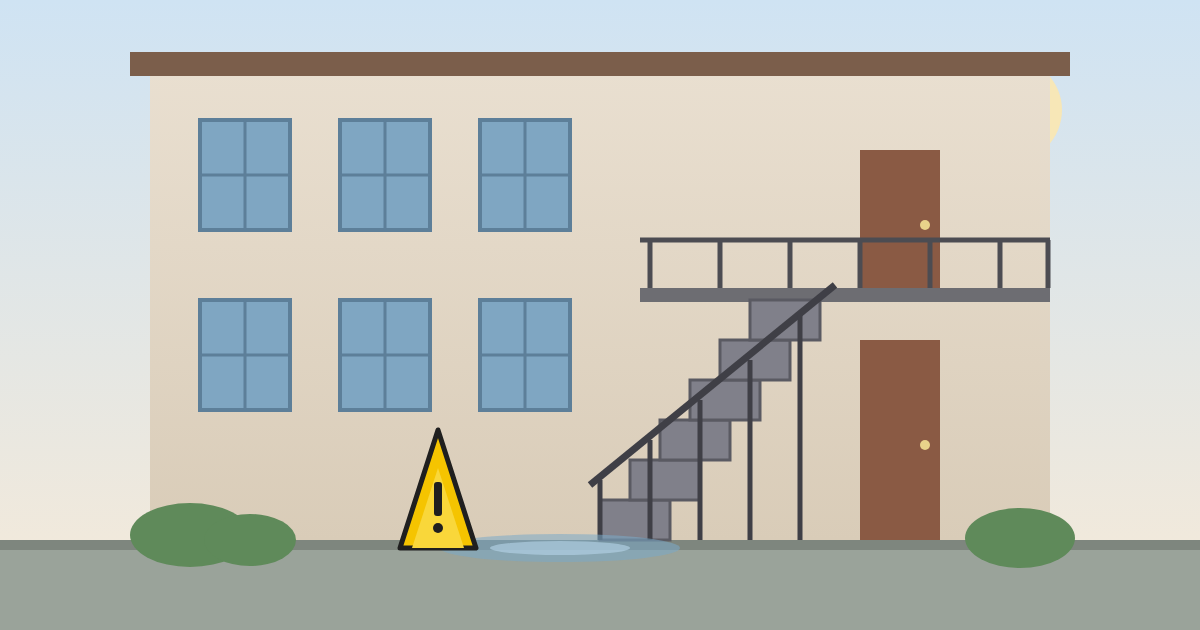
Landlords are responsible for keeping common-area stairs and walkways safe.
Can You Sue Your Apartment Complex for a Slip and Fall in California?
Yes. California law requires property owners, including apartment landlords, to use reasonable care to keep their property safe. If a landlord’s carelessness caused your fall and you were hurt, you can bring a claim against the owner, the management company, or both. That duty comes from Civil Code section 1714.
Lawyers call this a premises liability claim, meaning a claim that a dangerous condition on someone’s property injured you. Our premises liability practice area covers the other kinds of property cases we handle.
Landlords don’t have to be perfect. They have to be reasonable. One who inspects, fixes problems quickly, and warns tenants about hazards that can’t be fixed right away has met the standard. One who ignores a broken stair rail for three months has not.
When the Landlord Is Legally Responsible
To win, you have to prove four things:
- The landlord owed you a duty of care.
- The landlord breached it by creating the hazard or failing to fix it or warn you.
- That breach caused your fall.
- You suffered real damages, like medical bills or lost income.
The breach is the hard part, and it almost always comes down to what the landlord knew. We cover that below.
When You May Share the Blame
You can still recover if you were partly at fault. California follows pure comparative negligence, so your compensation is reduced by your share of the blame instead of wiped out. If a jury puts 20% of the fault on you, you recover 80% of your damages.
Expect the landlord’s insurer to push that number up. You were on your phone. The step was “obviously” cracked. Don’t accept their version of your fall.
Common Areas vs. Your Own Unit: Who Is Liable for What
Landlords generally control the common areas, so that’s where their duty is clearest. Inside your unit, the question is usually whether you told them about the problem and they sat on it.
Stairs, Walkways, Lobbies, Garages and Pools
Common areas are where most apartment falls happen, and where the landlord’s duty is clearest. Think broken or poorly lit stairs, loose handrails, wet laundry room floors, cracked walkways, torn carpet in a hallway, and slick pool decks. Nobody else controls those spaces. If it’s a hazard, it’s the landlord’s to fix.
Responsibility can spread beyond the owner. A management company or a maintenance contractor may share the blame, and we name every party that played a part. If you fell in the garage, our guide to parking lot accidents covers the issues specific to lots.
Hazards Inside Your Apartment
Inside your unit, a landlord is generally liable when they knew about a dangerous condition, or had good reason to know, and failed to repair it in a reasonable time. A leak under the sink that rots the floor. A loose stair tread inside a townhome unit. California’s habitability rules, in Civil Code section 1941.1, list floors, stairways, and railings among the things a landlord must keep in good repair.
This is where your paper trail matters. Send repair requests in writing, by email or text, and keep copies. “I told the super in the hallway” is hard to prove. A dated text message is not.
What Makes an Apartment Slip and Fall Claim Strong
A strong claim shows that the landlord knew about the hazard, or should have, and did nothing in time. Everything else supports that point.
Proving the Landlord Knew (or Should Have Known)
There are three ways to show it:
- The landlord or an employee created the hazard.
- The landlord was told about it, through a tenant complaint or repair request.
- The hazard existed long enough that a reasonable inspection would have caught it.
That third path wins many cases. In Ortega v. Kmart Corp. (2001), a store case, the California Supreme Court held that an owner’s failure to inspect reasonably can help show it should have known about a hazard. You don’t have to prove exactly how long it sat there. Insurers raise the “we didn’t know” defense against tenants every day. Maintenance logs and complaint history are how you answer it.
Evidence to Gather Right Away
Evidence in an apartment complex disappears faster than people think. Cameras record over footage, and a repaired step looks like it was never broken.
- Photos and video of the hazard, taken before anyone fixes it
- Your repair requests and any complaints from neighbors
- Names and numbers for witnesses
- A copy of the incident report, if management made one
- Medical records from your first visit forward
- A written request that management preserve security footage
How Much Are Apartment Slip and Fall Settlements Worth?
There’s no reliable average, and anyone who quotes one without knowing your injuries is guessing. A sprain that heals in a month and a shattered hip that changes how you live are worth very different amounts. What matters is what your injuries cost you and how well you can prove the landlord’s fault.
What Drives the Number
| What gets counted | How it affects your settlement |
|---|---|
| Medical bills | ER, surgery, therapy, and the future care you’re likely to need. This is the foundation of most claims. |
| Lost income | Time off work, plus any lasting loss in what you can earn. |
| Pain and suffering | Physical pain and the effect on daily life. It grows with severity and recovery time. |
| Your share of fault | Reduces the total by your percentage of the blame. |
| Strength of proof | Notice evidence and documentation decide how seriously the insurer treats you. |
| Insurance coverage | The owner’s liability policy limits can cap what’s realistically collectible. |
Insurers don’t pay on the number of your bills alone. They pay on what they think a jury would do. Our pain and suffering calculator shows how the non-economic piece is usually estimated.
How Long a Settlement Takes
Some claims settle within months after you finish treatment. Disputed ones take longer, and filing a lawsuit adds more time. Don’t settle before you know the full extent of your injuries. Once you sign a release, you can’t reopen the claim when the pain doesn’t go away. Our breakdown of how long a personal injury lawsuit takes in California walks through the stages.
Deadlines for Suing an Apartment Complex in California
You generally have two years from the date you were injured to file a personal injury lawsuit in California, under Code of Civil Procedure section 335.1. Miss it, and the court will likely dismiss your case, with only narrow exceptions.
If a government agency owns the housing, such as a public housing authority, the clock is much shorter. A claim usually has to be filed within six months under Government Code section 911.2, and before you can sue. Relief for a late claim is limited. Our guide to the California Tort Claims Act explains how that process works. Find out who owns your building early, because ownership decides which deadline applies to you.
Do You Need a Lawyer to Sue Your Apartment Complex?
You don’t need one to file, but you’re up against a landlord’s insurance company with adjusters whose job is to pay you less. A lawyer pulls the maintenance records, preserves the video, and deals with the insurer so you can focus on healing.
You don’t pay anything upfront. We work on contingency, so there’s no fee unless we win. Our team has recovered nearly $250 million for clients and has a 98% success rate, and we answer the phone 24 hours a day. If you were hurt at an apartment complex in San Diego County, call us at (619) 333-5555 and we’ll talk through your case.
Frequently Asked Questions
Can I sue my apartment complex if I slipped and fell?
Yes, if the landlord’s negligence caused your fall and you were hurt. You have to show the landlord knew about the hazard, or should have known, and didn’t fix it or warn you in time. Photos, repair requests, and medical records make that much easier to prove.
How much does it cost to sue an apartment complex?
Most injury lawyers, including our team, work on contingency, which means you pay no attorney fees unless the case is won. The fee comes out of the recovery. Ask any lawyer to explain case costs in writing before you sign.
How hard is it to win a slip and fall lawsuit against a landlord?
It’s harder than most people expect, because you have to prove the landlord knew or should have known about the hazard. Claims with documented complaints, clear photos, and prompt medical treatment are much stronger. Waiting weeks to get care makes a case tougher, and if the hazard was obvious, the insurer will argue you share the blame.
Can you sue an apartment complex for pain and suffering?
Yes. Pain and suffering is part of the non-economic damages in a California injury claim, alongside medical bills and lost income. How much it adds depends on how severe your injuries are and how long recovery takes.
How long do I have to file an apartment injury claim in California?
Generally two years from the date you were hurt. If a public entity such as a housing authority owns the building, a claim is typically due within six months. The deadline depends on who owns the property, so check early.
Hurt at your apartment complex? Call Batta Fulkerson at (619) 333-5555. No fees unless we win.

We trust you found value in this blog article: Apartment Slip and Fall Settlements in California. We also hope you never need us, but if you or anyone you know might, we are always here to help!